Tuesday, 16 April 2013

C1b Using Carbon Fuels

You need to be able to:
  • Evaluate fuels for a particular purpose (considering availability, cost, energy value, pollution, ease of use, toxicity and storage)
  • Explain the complete combustion of hydrocarbon fuels (plentiful oxygen, lots of heat energy produced, carbon dioxide and water produced, word equations and balanced symbol equations, link to Bunsen flame, advantages over incomplete combustion)
  • Explain the incomplete combustion of hydrocarbon fuels (oxygen, shortage, some heat energy produced, carbon monoxide, carbon and water produced, word equations and balanced symbol equations, link to Bunsen flame, link to poisoning)

  1. Combustion notes from AUS-e-TUTE 


  2. Carbon monoxide build up.

C1a Making Crude Oil Useful

You need to be able to:
  • Describe the composition of crude oil (non-renewable fossil fuel, problems because of this, hydrocarbon mixture)
  • Explain how the fractional distillation of crude oil works (labelled distillation column with fractions, bond type that breaks)
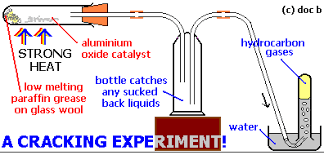
  • Explain the cracking of fractions (why it's done, how it's done in the lab, how it's done on a larger scale, link to supply and demand)

  1. Lots of notes on crude oil and making it useful
  2. doc b oil notesGCSE Notes from Doc Brown
  3. Videos and simulations on crude oil and its products

B1h Variation and Inheritance

You need to be able to:
  • Identify characteristic as environmental, inherited or both
  • Understand and apply the terms; "chromosome, gene, allele, dominant, recessive, genotype, phenotype, dominant, recessive"
  • Construct and use genetic cross diagrams for gender determination, family pedigrees of inherited disorders and for inherited characteristics (e.g. eye colour)

  1. Variation and inheritance notes
  2. Reading, flash cards, quiz and more on genetic variation
  3. Key terminology meanings
  4. Interactive eye colour calculator

B1g Controlling Plant Growth

You need to be able to:
  • Describe, explain and conclude from experiments investigating plant's response to light
  • Explain phototropism and geotropism (including the role of auxin)
  • Expalin how plant hormones are used commercially
  1. Tutorial on tropisms (you don't need to understand thigmotropism)
  2. Geotropism and phototropism notes from the BBC
  3. Quiz on auxin and plant growth
  4. Notes and questions on tropisms

B1f Staying in Balance

You need to be able to:
  • Explain what homoeostasis is and how negative feedback loops maintain it
  • Explain thermoregulation (what, why needed, how, what if it doesn't happen) 
  • Explain the control of blood sugar (why needed, how, what if it doesn't happen)
  1. S-cool notes on homeostasis
  2. Human homeostasis notes

B1e Drugs and You

You need to be able to:

  • Explain the classification of drugs (harmful/beneficial/prescription, legal classification with examples and effects, stimulants/depressants with examples and what they do to the synapses)
  • Explain how smoking causes health problems (CO2, nicotine, tars, particulates, particular focus on the cause of smoker's cough)
  • Explain the effect of alcohol (short term, long term - particular focus on cirrhosis, social impacts - data analysis)
  1. Bitesize notes on drugs.
  2. Drugs and bad body maintenance notes
  3. Interactive body map showing the effects of alcohol


B1d The Nervous System

You need to be able to:

  • Explain how the eye works (focus near and far, functions of each part, how long/short sight can be corrected, advantages and disadvantages of monocular and binocular vision)
  • Describe the nervous system and the cells in it (neurones adapted to their function)
  • Describe reflex and voluntary action (reflex arc, spinal reflex, synapses)
  1. The nervous system and senses notes
  2. Website explaining the nervous system, with further links
  3. Short sight animation and diagrams
  4. Long sight animation and diagrams
  5. Bitesize notes on the eye (look at all the pages)
  6. A nerve cell
  7. Reflex arc
  8. A synapse